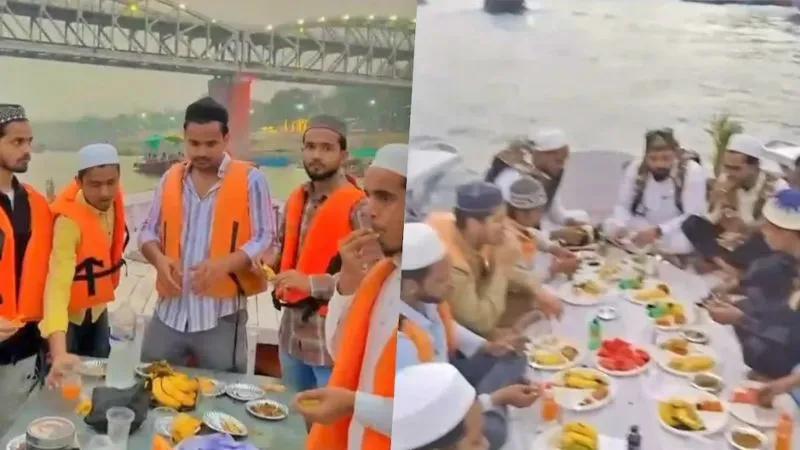
A video has surfaced from the Varanasi district of Uttar Pradesh showing some Muslim youths holding an iftar party on a boat in the Ganga river while consuming non-vegetarian biryani. Taking cognisance of the video, BJP metropolitan youth president Rajat Jaiswal filed an FIR. The police acted and arrested 14 people. Now, Congress and the left-liberal ecosystem have come out in defence of these Muslim individuals.
Congress leaders did not find anything wrong with consuming non-vegetarian biryani in the Ganga River, which is considered sacred in Sanatan Dharma. Instead, they began questioning the faith of Hindus. Congress leader Supriya Shrinate asked what law these Muslim individuals had broken. She questioned what their “sin” was and, in doing so, raised broader questions about the direction in which society is heading.
An FIR has been filed against 14 Muslim men who hosted an Iftar on a boat on the Ganges in Varanasi.
What laws have they broken?
What sin have they committed?Where are we headed?
Sick
pic.twitter.com/mS07f0FXMy— Supriya Shrinate (@SupriyaShrinate) March 17, 2026
However, she herself conceals what many consider the core issue. According to her, it was merely an iftar party, which every Muslim has a religious right to observe during the month of Ramadan. But she omits the fact that non-vegetarian food was being consumed in the sacred Ganga river, and even chewed bones were thrown into its waters. This act reportedly took place right in front of the Bindu Madhav temple.
Congress, which is justifying this by calling it an iftar party, appears to be ignoring even Islamic viewpoints, as some clerics themselves have criticised the act. S.M. Yasin, joint secretary of Anjuman Intezamia Masajid in Varanasi, condemned it, stating that iftar is a religious act, not a picnic. He also emphasised that Maghrib prayers should be offered immediately after iftar.
Congress is accused of selectively hiding facts because acknowledging them would reveal that the act may have been deliberate. Critics argue that this could be an attempt to project secularism. At the same time, they question why Congress does not raise similar concerns in other cases, such as the killing of a Hindu youth named Tarun in Uttam Nagar, Delhi, or incidents where religious sensitivities are cited over relatively minor issues.
Some commentators have questioned why throwing bones into the Ganga is being treated as an offence while immersion of ashes is considered acceptable.
Wasim Akram Tyagi, associated with Islamist commentary, asked what the crime was: eating chicken biryani on a boat or throwing bones into the river. He further questioned whether, by that logic, immersion of ashes, cremation ghats along the river, or even carnivorous aquatic life should also be considered problematic.
अपराध क्या है? नाव में चिकन बिरयानी खाना या गंगा में हड्डी फेंकना? अब सवाल यह है कि यह अपराध कैसे है? अगर यह अपराध है तो फिर इसी गंगा में अस्थियां विसर्जित की जाती हैं! तब तो वो भी अपराध है? इसी गंगा के तट पर जगह-जगह शमशान घाट हैं, जली अधलजी लाशें उसमें बहा दी जाती हैं, तब तो वह… pic.twitter.com/weXs8gIFut
— Wasim Akram Tyagi (@WasimAkramTyagi) March 17, 2026
Faith, the Ganga, and the difference between ashes and bones
In the Varanasi case, the issue is not with Muslims holding an iftar party per se; the objection arises from the consumption of meat in the Ganga river under the guise of such a gathering. In Hinduism, the Ganga is not merely a river; it is the holiest of rivers, revered and worshipped as a living goddess. It is believed to cleanse sins, grant moksha (liberation), and sustain life itself.
Across the Vedas, Puranas, Ramayana, and Mahabharata, the Ganga is described as a divine river. According to tradition, it descended from heaven to earth through the penance of King Bhagirath, with Lord Shiva bearing its force, to grant salvation to the 60,000 sons of King Sagar. Bathing in its waters is believed to purify the soul and accrue spiritual merit. In Sanatan Dharma, Ganga jal is indispensable in rituals, consecration, and purification, while grand religious events like the Kumbh Mela are held on its banks. It is, therefore, venerated as life-giving Mother Ganga.
The practice of immersing ashes in the Ganga also carries deep theological significance. As described in the Garuda Purana, immersing the remains after cremation is believed to help the departed soul attain moksha, heaven, or Brahmaloka. Since the Ganga is considered to have descended from the heavens, it is believed to liberate ancestral souls and break the cycle of rebirth.
These beliefs form the core of Hindu reverence for the Ganga. It is within this framework that the distinction between immersing ashes and discarding bones or food waste becomes crucial. One is a sacred rite rooted in centuries of religious tradition; the other is seen as an act of disregard toward those very sentiments. This distinction explains why the incident in Varanasi, where a non-vegetarian iftar gathering reportedly involved such actions, is perceived by many as hurtful to religious sensibilities.
Law, restraint, and selective outrage
The depth of Hindu faith in the Ganga is widely understood across India. This makes actions perceived as disrespectful in such spaces particularly sensitive. If such acts are not seen as deliberate provocations, it raises legitimate questions about intent. It is worth asking: would a Hindu engage in religious practices inside a mosque in a similarly insensitive manner? Such parallels are often invoked to highlight perceived asymmetries in public discourse.
Critics argue that sections of Congress and the broader left-liberal ecosystem selectively frame such incidents, questioning the legal basis of action while overlooking the cultural and religious context. This, they contend, creates an impression that secularism is applied unevenly, asserted strongly when Hindu concerns are involved, but diluted when addressing similar expectations from others.
At the same time, it is important to note that the response in this case followed a constitutional route: a complaint was filed, the police took cognisance, and arrests were made in accordance with due process. This underscores a key point often highlighted in such debates, that grievances, even when rooted in faith, are pursued through legal mechanisms rather than extrajudicial means.
Yet, critics maintain that the same voices that invoke religious freedom in this context often remain muted on instances of violence carried out in the name of religious extremism. This perceived inconsistency continues to fuel the larger debate around secularism, rights, and responsibilities in a plural society.