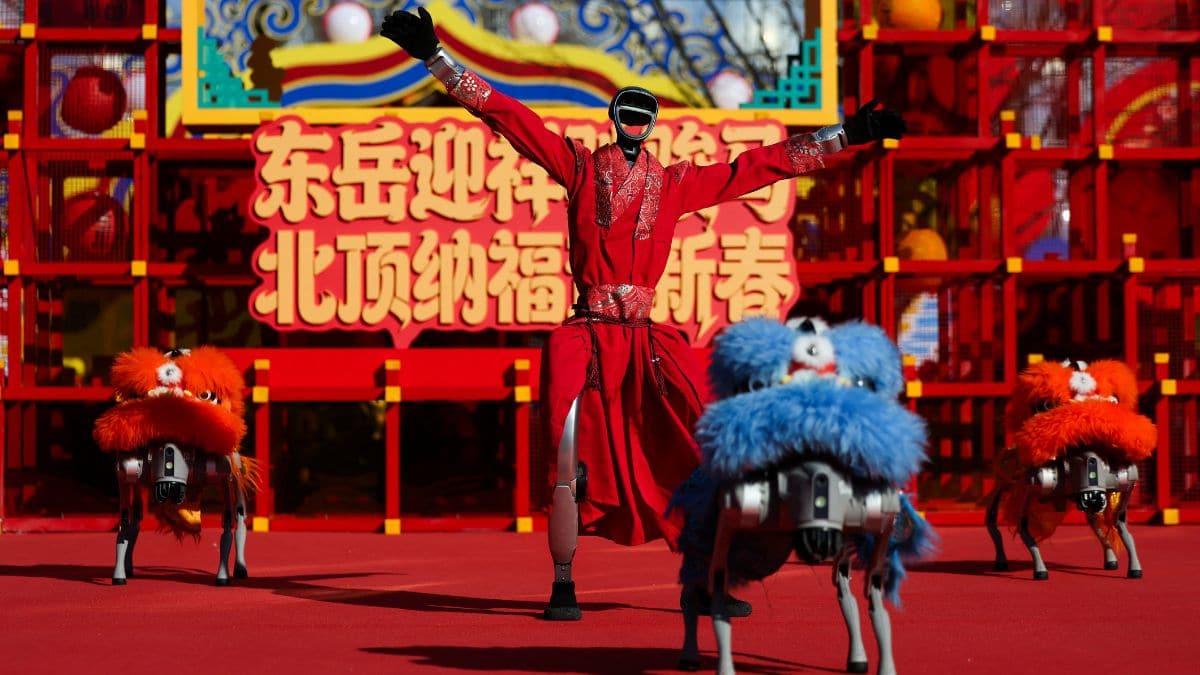
Humanoid robots performing martial arts, backflips and synchronised dance routines became one of the most talked-about moments of China’s Lunar New Year celebrations this week, as the country’s most-watched television broadcast placed advanced robotics at the centre of its cultural showcase.
The performances, staged during the annual Spring Festival Gala on February 16, offered millions of viewers a highly visible demonstration of how far China’s humanoid robotics sector has progressed in just a year.
Broadcast nationally by China Media Group on CCTV, the gala has long served as a platform through which Beijing presents its technological ambitions to both domestic and global audiences.
This year, humanoid robots were no longer side attractions but featured repeatedly in prominent segments of the roughly four-hour programme.
How did robots become the stars of China’s biggest TV event?
The Spring Festival Gala occupies a unique place in China’s media landscape. In 2025, the programme captured 79 per cent of live television viewership nationwide, making it one of the most widely watched annual broadcasts in the world.
Often compared to United States’ Super Bowl in terms of its cultural prominence and reach, the gala has historically been used to highlight Beijing’s achievements in areas ranging from space exploration to infrastructure and emerging technologies.
This year, the first three major sketches prominently featured robots performing alongside human actors and martial artists. One extended sequence involved more than a dozen humanoid robots executing choreographed combat routines with swords, poles and nunchucks in close proximity to children.
The performance included a technically complex segment inspired by the “drunken boxing” style of martial arts, characterised by deliberate imbalance, staggered steps and backward tumbles.
The robots’ ability to imitate this style required fine-tuned control over balance and movement, as well as the capacity to regain an upright posture after falling — a capability known in robotics as fault recovery.
Several Chinese robotics firms were given prime-time exposure during the broadcast. Unitree Robotics showcased humanoids that performed martial arts movements alongside young human practitioners.
MagicLab presented robots dancing in synchronised routines with pop singers during a segment titled “Intelligent Manufacturing Future,” while its robotic dogs appeared in panda costumes during another performance.
Noetix Robotics demonstrated humanoid robots designed to resemble real people, including a comedy sketch in which an actress introduced an android version of herself.
Galbot used its slot to show a robot performing practical domestic tasks such as cracking walnuts, skewering sausages and folding clothes.
Artificial intelligence tools also featured prominently. ByteDance’s chatbot Doubao appeared in the opening sketch of the programme. Throughout the broadcast, the company distributed digital red envelopes containing virtual cash to users of its AI app.
ByteDance also confirmed that its AI video-generation model Seedance 2.0 contributed to the visual design of several performances.
What exactly did this year’s robots demonstrate on stage?
The most striking aspect of
the 2026 gala performances was the visible leap in technical capability compared with the previous year. In 2025, viewers saw humanoid robots executing limited, repetitive motions such as basic walking, twisting and simple dance steps.
The 2026 routines, by contrast, involved coordinated sequences across multiple machines, dynamic martial arts movements, aerial flips and controlled landings on their knees without collapsing.
Unitree’s robots demonstrated agility by kicking, flipping and wielding nunchucks in close proximity to human performers, maintaining synchronisation with music and choreography cues.
.@UnitreeRobotics robots join martial artists in a synchronized dance at China’s 2026 Lunar New Year Gala. Truly mesmerizing! 🧧
Exciting collab or glimpse of the future? pic.twitter.com/CPEcms8aFv
— David Goldstick (@innov8ion) February 18, 2026
The ability of robots to recover from falls — a critical benchmark in humanoid robotics — was demonstrated repeatedly during the drunken boxing-inspired sequence, where intentional instability formed part of the routine.
MagicLab’s dance performance with human singers showed improved timing and synchronisation across multiple robots operating simultaneously.
Noetix’s humanoid, designed to closely resemble a human, highlighted aesthetic and design elements aimed at making robots appear more lifelike in social and entertainment contexts.
Galbot’s domestic-task demonstrations showcased dexterity in manipulating small objects, such as walnuts and clothing items, pointing to potential applications in service environments.
Experts noted that the coordinated operation of large numbers of similar humanoid robots represented a meaningful milestone.
Georg Stieler, Asia managing director and head of robotics and automation at Stieler Technology and Marketing, said the ability to deploy many near-identical machines in synchronised routines reflected progress in motion control and systems integration.
“What distinguishes the gala from comparable events elsewhere is the directness of the pipeline from industrial policy to prime-time spectacle,” Stieler told The Guardian.
“Companies that appear on the gala stage receive tangible rewards in government orders, investor attention, and market access.”
He also highlighted the pace of improvement over just one year. “It’s been just one year – and the performance jump is striking,” he said, adding that the robots’ enhanced motion control reflected Unitree’s focus on developing robot “brains,” the software systems that enable fine motor skills relevant to real-world manufacturing environments.
Are these performances proof of real-world readiness?
While the gala showcased visible technical progress, experts cautioned against equating stage performances with industrial reliability. Kyle Chan, a technology analyst at the Brookings Institution, argued that public robot displays serve a strategic communication function for Beijing.
“Unlike AI models or industrial equipment, humanoid robots are highly visible examples of China’s technological leadership that general audiences can see on their phones or televisions,” he told The Guardian.
Chan linked the prominence of humanoid robots to intensifying competition between China and the United States in advanced technologies. “While China and the US are neck-and-neck on AI, humanoid robots are an area where China can claim to be ahead of the US, particularly in terms of scaling up production,” he said.
Stieler stressed that the routines were the product of repeated training cycles rather than adaptable intelligence. “Stage performance does not equate to industrial robustness, yet,” he said.
“These dance motions involve very little environmental perception and are essentially imitation learning plus a balance-keeping controller. That has little bearing on reliability in unstructured environments, a prerequisite for factory-grade deployment. Also the progress in dexterity is not as fast as in locomotion.”
How does this fit into China’s strategy?
The prominence of humanoid robots at the gala reflects broader policy priorities embedded in national strategies such as Made in China 2025 and the 14th Five-Year Plan, both of which identify robotics and artificial intelligence as key sectors for economic upgrading.
By the end of 2024, China had registered 451,700 smart robotics companies with a combined capital base of 6.44 trillion yuan, according to official data.
China is already the world’s largest market for industrial robots and accounted for more than half of all industrial robots installed globally in 2024, according to the International Federation of Robotics.
Humanoid robots, though still a small subset of the overall robotics market, have become a focal point for public-facing demonstrations of technological capability.
Research firm Omdia estimates that China accounted for 90 per cent of the approximately 13,000 humanoid robots shipped worldwide last year. Morgan Stanley projects that China’s humanoid robot sales will more than double to 28,000 units in 2026.
Elon Musk, whose company Tesla is developing its own humanoid robot Optimus as part of its shift toward embodied AI, said, “People outside China underestimate China, but China is an ass-kicker next level,”
he said last month.
Marina Zhang, a technology professor at the University of Technology Sydney, told The Guardian that the gala’s heavy emphasis on robotics signalled a shift in China’s manufacturing strategy, “where robotics becomes a linchpin in the shift from low-cost assembly to high-end, smart manufacturing”.
Why is global competition shaping how these robots are presented?
The gala’s robotics-heavy programming took place against the backdrop of intensifying technological competition between China and the United States.
Analysts noted that humanoid robots offer a particularly legible form of technological demonstration because their human-like form makes advances in balance, coordination and dexterity immediately visible to non-expert audiences.
Beijing-based analyst Poe Zhao described humanoid robots as a narrative device that brings together multiple areas of national strength.
“Humanoids bundle a lot of China’s strengths into one narrative: AI capability, hardware supply chain, and manufacturing ambition. They are also the most ’legible’ form factor for the public and officials,” Zhao told Reuters.
“In an early market, attention becomes a resource.”
The prominence of robots at the gala also coincided with commercial developments in the sector. Major players such as AgiBot and Unitree are preparing for initial public offerings in 2026, while domestic AI startups released multiple advanced models during the Lunar New Year holiday period.
How did Chinese audiences react to the robot showcase?
Public reaction to the robot-heavy gala was mixed. On Weibo, posts related to the performances accumulated millions of views. Some users expressed pride at the visible progress of Chinese robotics.
One widely shared comment stated, “This is the most stunning performance at this year’s Spring Festival Gala. It might even send shock waves across the Pacific.”
I live in China, and right now I’m watching the Chinese New Year Eve Spring Festival Gala. On the screen, AI robots developed by Unitree Robotics are performing traditional Chinese martial arts. The combination of advanced technology and traditional culture is truly breathtaking.… pic.twitter.com/ymeV7eXnV4
— AngelinaTo1M (@AngelinaTo1M) February 16, 2026
Others voiced concern that the emphasis on robots overshadowed human performers. Another widely circulated comment read, “We are looking for humans amid all the robots.”
State media portrayed the gala as a catalyst for consumer interest in robotics. Reports indicated that robots from MagicLab, Unitree and Noetix sold out on JD.com after being featured during the broadcast.
What pressures are robotics firms facing as expectations rise?
The high-profile nature of the gala has also placed growing pressure on robotics firms to demonstrate visible progress year after year. Unitree CEO Wang Xingxing acknowledged the stakes involved in preparing for the 2026 performance.
“In the past one or two months, I’ve personally been under quite a lot of pressure. We had to deliver a performance that was significantly better than last year’s,” he said, as quoted by CNN.
“We hope that through our company’s efforts – and through the collective efforts of society as a whole – we can help advance the development of the entire robot industry.”
Dozens of companies are now piloting humanoid robots in assembly lines, logistics centres and research facilities, supported by state subsidies aimed at accelerating deployment.
While humanoids remain more visible in entertainment and promotional contexts, 2026 is widely seen within the industry as a year when attention will increasingly shift toward real-world industrial use cases.
Also Watch:
With inputs from agencies
End of Article