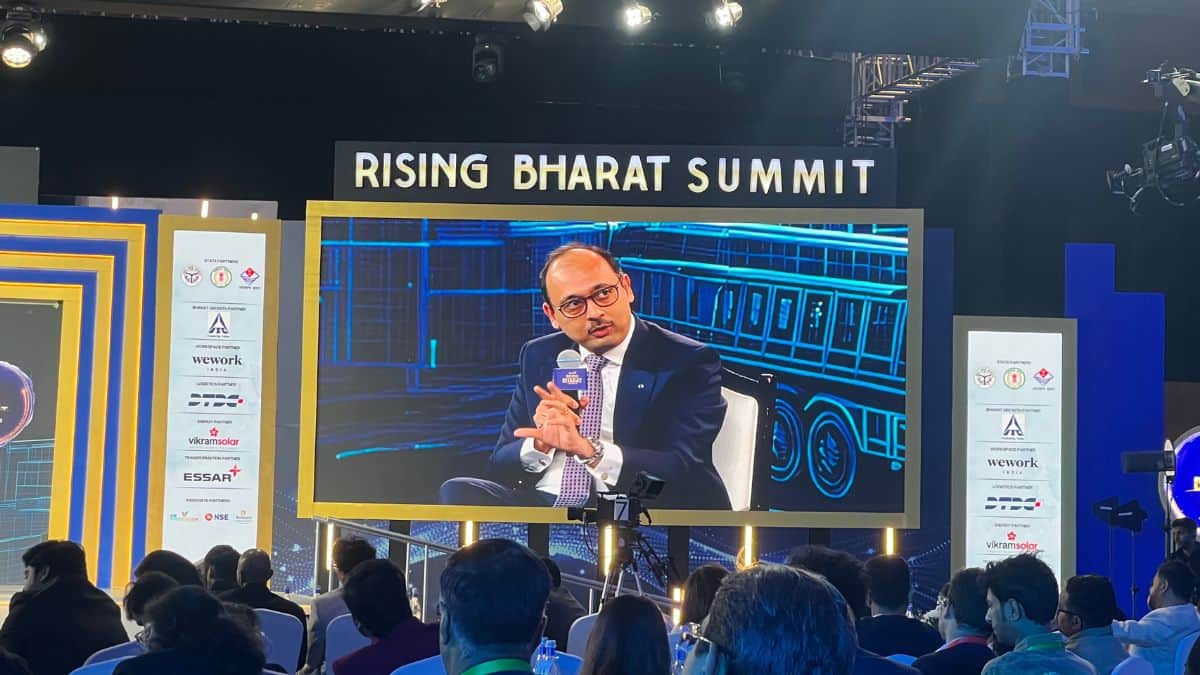
At the Rising Bharat Summit 2026 in New Delhi on Friday, the leadership of Mercedes-Benz India delivered a brief view of the company’s strategic direction in India amid a transforming global automotive environment.
Managing Director and CEO Santosh Iyer addressed how Mercedes is repositioning itself in the subcontinent.
As Mercedes-Benz India stepped into 2026, its focus evolved from sheer volume to a value-driven luxury agenda. The company’s performance in recent years — including record revenue, a widening product portfolio, and stronger localisation — reflects this shift.
How Mercedes-Benz India has performed
Despite registering a modest decline in total volume, Mercedes-Benz India capped the calendar year 2025 with its highest-ever revenue — just shy of $1.5 billion.
According to company data, Mercedes India reported 19,007 units sold in 2025, a slight dip from 19,565 in 2024 — equating to a nearly 2.85 perc ent year-on-year drop.
What stands out, however, is where growth occurred. Top-end vehicles — those priced above ₹1.5 crore, including the S-Class, AMG performance variants, Maybach and EQS electric models — contributed disproportionately to revenue gains and brand positioning.
These premium models expanded by around 11 per cent in volumes, now representing roughly a quarter of total sales. AMG vehicles alone grew by 34 per cent, a marker of increasing enthusiasm in India for performance luxury cars.
At the same time, the “Core” segment — dominated by models such as the E-Class long wheelbase and GLE SUV — continued to be the backbone of Mercedes’ India operations, accounting for about 62 per cent of sales in 2025.
Industry analysts also note that diesel variants have seen resurgence in demand following India’s GST 2.0 reforms, with diesel options accounting for an estimated 43 per cent of Mercedes’ sales mix — a notable figure in a global landscape where diesel is declining.
How Mercedes-Benz India sees the India-EU FTA
One of the most consequential global trade developments affecting Mercedes and the Indian automotive market at large is the recently concluded India-European Union Free Trade Agreement (FTA), announced on January 27 after nearly two decades of negotiations.
At the Rising Bharat Summit, Santosh Iyer emphasised that trade agreements should be viewed broadly as platforms for holistic economic engagement rather than mere tariff reduction tools.
“FTAs while people only clock in terms of reduction of tariffs, but as we look at the various countries where FTAs are being done, it is creating a business platform which opens engagement as well as investments.”
“It’s not just a government-to-government but a business-to-business partnership.”
Under this landmark pact, import duties on fully built European cars were committed to being slashed from their historically steep peaks of up to 110 per cent down to as low as 10 per cent over time, under specific quota systems covering roughly 250,000 vehicles annually.
However, the transition is gradual. In the first phase, immediate tariff cuts to about 40 per cent have been agreed for a limited number of imported cars, with further reductions reaching 10 per cent over subsequent years, subject to quota and regulatory conditions — a strategy designed to liberalise trade without overwhelming the domestic industry.
“FTAs are not about duty reduction. We have always advocated open borders and that is the fundamental reason for global economic growth. The real potential of India is to be able to participate in developed economies and we have prepared India already,” Iyer added.
While this move promises to enhance market access for European automakers like Mercedes-Benz, BMW and Volkswagen, experts caution that widespread price reductions for most imported luxury cars may not materialise overnight.
That’s because a large share of premium cars sold in India is already locally assembled or falls under tariff protections during phased implementation.
Therefore all Mercedes models may not become significantly cheaper in India purely because of the FTA, particularly given localisation and GST implications, as well as residual duties and other taxes.
Nevertheless, the pact’s deeper significance lies beyond immediate pricing. Expanded market access under the FTA is anticipated to boost Indian automotive exports into the EU — which have been gaining momentum, recording $2.2 billion in shipments between April and December 2025, up from $1.6 billion in 2024.
“There is a clear discussion about protection of investments for European companies in India, that also means more capex and more growth momentum. FTA will be one of the biggest game changers in the next couple of months if not years,” Iyer pointed out.
Beyond automobiles, the India-EU FTA reduces or eliminates tariffs on a wide range of goods from processed foods to industrial products, positioning it as one of India’s most sweeping trade pacts or as it is being touted — the “mother of all deals”.
India vs China: Mercedes’ market palette
Comparing Mercedes-Benz’s strategic positioning and performance across India and China reveals contrasting market dynamics.
China has long been Mercedes-Benz’s largest single market globally. The company sold approximately 551,900 to 575,000 units across China in 2025, highlighting the massive difference in volume when it comes to India.
The automotive ecosystem in China is defined by massive capacity,
intense competition from domestic electric vehicle (EV) manufacturers, and strong governmental emphasis on scale production and aggressive localisation.
Price-competitive homegrown EV brands have pressured traditional luxury volumes, contributing to sales declines for some foreign manufacturers in recent years.
Mercedes leadership has noted that China’s market structure — heavily influenced by state intervention, subsidy frameworks and production-oriented growth — differs markedly from India’s market evolution.
At the summit, Iyer summed up this contrast, stating, “China’s growth was state-led with a lot of capex and subsidies. Targets for production were set. Whereas India’s growth is consumer economy-led. China has overcapacity now. It is more structural in India — a bit slower than imagined — but the runway is there,” he explained.
“The biggest change point in the last 20 years is decarbonisation,” he said. “China did not have that agenda as much as what India has for growth.”
In contrast, India’s luxury market is characterised by sustainable, demand-led growth, strong interest in premium and performance vehicles, and rising income profiles in urban centres.
India’s luxury volumes — while smaller in scale than China — have shown resilience and a strengthening foothold for brands like Mercedes-Benz, especially when paired with deep localisation that keeps pricing competitive.
This positioning is reflected in Iyer’s remarks, as he stated, “If you only look at the volume from one single prism, it may not sit right. But structurally, it’s showing a very positive trend.”
“FTAs are not about duty reduction. We have always advocated open borders and that is the fundamental reason for global economic growth. The real potential of India is to be able to participate in developed economies and we have prepared India already,” Iyer said.
“The automotive ecosystem here is very strong. The balance of trade of auto components to Europe is positive for India. We are exporting to Europe more than importing from there,” he noted.
Unlike China’s market, India’s regulatory environment has not relied on heavy subsidies for pure EV adoption, which has led to more balanced demand between internal combustion engine (ICE) models, diesel variants, and electrified vehicles — especially in the luxury bracket.
This India-China contrast explains why Mercedes is increasingly viewing India not just as a strong growth market but as a strategic hedge, especially given China’s slower luxury sales growth in 2025 and competitive price dynamics from local EV brands.
“From a low-selling, cheaper cars to today our average selling price is coming to Rs. 1 crore,” Iyer revealed.
How Mercedes-Benz India is expanding locally
Mercedes-Benz India continues to deepen localisation, both on assembly and technology fronts. A significant proportion of its portfolio is assembled locally via CKD (completely knocked down) operations, which helps keep effective tariffs lower than for fully built imports.
This localisation also shields many models from immediate impact under new trade agreements and is aimed at highlighting India’s growing importance as a production hub.
Industry data suggests that nearly 95 per cent of luxury cars sold in India that qualify under the premium segment are locally assembled, meaning that the bulk of tariff reductions under new trade pacts will benefit niche imports more than the mass of locally built vehicles.
The company has also invested in its Bengaluru-based R&D centre, which plays an increasingly important role not just for domestic innovation but for global Mercedes programmes.
This includes work on digital systems, advanced driver assistance capabilities, and connected car technologies — areas where India’s engineering talent is highly competitive.
Mercedes has announced a robust product expansion roadmap for 2026, with up to 12 new launches planned across combustion, electrified and performance variants.
These include the locally significant Mercedes CLA electric vehicle (EV), set to redefine the brand’s entry EV positioning in India, as recently confirmed by multiple automotive sources.
The News18 Rising Bharat Summit, one of India’s flagship events on current affairs is being held at Bharat Mandapam in New Delhi from February 27, 2026 to February 28, 2026.
End of Article