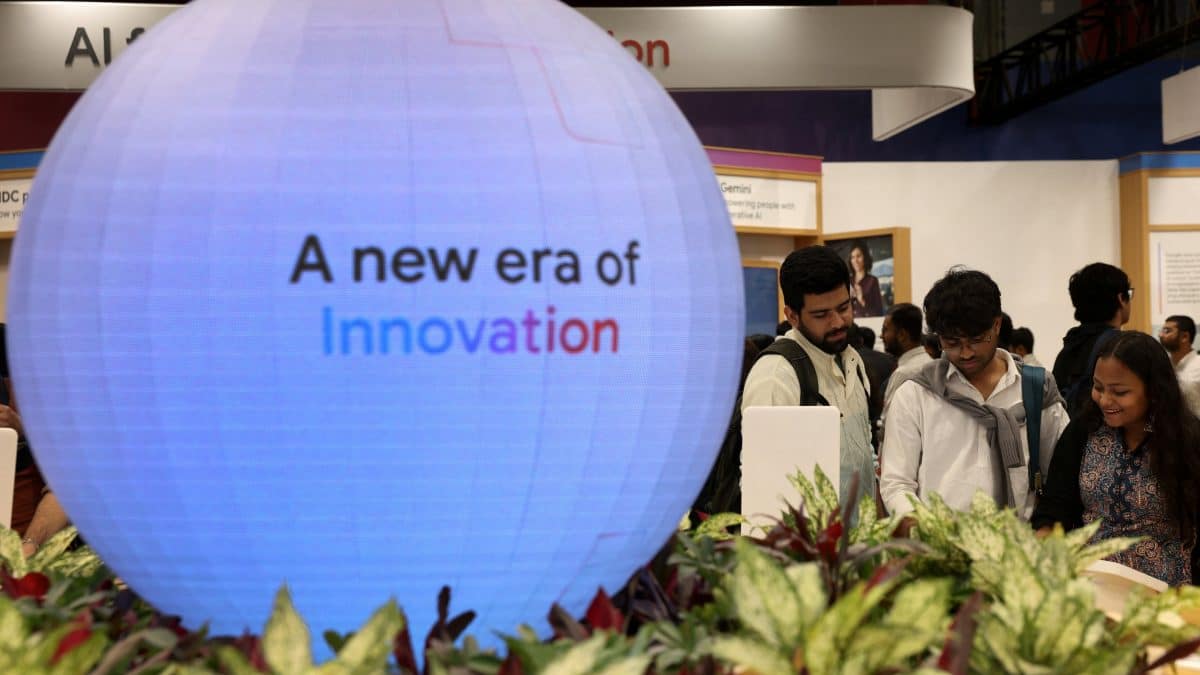
At the India AI Impact Summit, Ananya Sharma, Growth Manager, and Vishal Gupte, AI Solution Architect at Beyond Key, spoke to Firstpost’s Dheeraj Kumar about India’s AI trajectory, infrastructure bottlenecks, job disruption and the urgent need for responsible AI governance.
Edited excerpts:
How do you see India’s startup ecosystem evolving in AI compared with markets like the US or China?
Vishal Gupte: The government’s push toward AI in the public domain is actually a positive development. By embedding AI into digital public platforms, the ecosystem is becoming more inclusive. AI is no longer confined to technology companies—it is entering education, governance and grassroots innovation.
At recent regional AI summits, we saw school and college students actively engaging with AI. That cultural shift matters. When awareness broadens, the innovation pipeline strengthens. In the long run, that helps India build a sustainable AI ecosystem.
Ananya Sharma: India is already a major technology player. We are among the largest users of generative AI platforms globally. The upcoming workforce is becoming AI-ready, and enterprises are actively integrating AI agents into their workflows.
The people-centric focus—whether in agriculture, governance or education—does not restrict innovation. Rather, it ensures adoption at scale. With Industry 4.0, trade, manufacturing and services are increasingly AI-powered. India, as a global IT services hub, has significant scope to build and deploy AI solutions at scale.
This is a phase of preparation. The ecosystem is getting ready for large-scale AI-led transformation.
Is India becoming merely a deployment hub rather than a driver of AI innovation?
Ananya Sharma: India has historically led in multiple technology transitions. AI will be no different—provided we embed it across systems, industries and workflows.
We are in competition with markets like China and the United States, where AI adoption is already widespread. But small and medium enterprises (SMEs) in India will play a decisive role. To remain competitive in global markets, they must integrate AI into their offerings.
We are also seeing AI become a core part of academic curricula. Educational institutions are no longer treating AI as optional—it is foundational.
Vishal Gupte: What we observed at the summit is that AI in India is moving from experimentation to implementation. Startups are building real-world use cases—in agriculture, education and citizen services.
These may seem incremental today, but they are steps toward innovation maturity. As infrastructure improves—particularly in data centres and compute capacity—India can transition from being primarily a deployment base to a true innovation hub.
What opportunities excite you most about the Indian AI market? What challenges do you foresee?
Ananya Sharma: The opportunity lies in scale. India’s population, digital adoption and enterprise base create a massive market for AI-powered services.
However, awareness and deep technical understanding are still uneven. Many people know of AI but do not fully grasp its capabilities. Adoption will take time.
The larger challenges are governance and ethical usage. AI must be implemented responsibly. Data management practices—both at the organisational and governmental levels—will determine whether AI solves problems or creates new ones.
Vishal Gupte: There is a skill gap that needs to be bridged. While initiatives are underway, AI literacy must expand rapidly.
Infrastructure is another critical issue. Data exists, especially within government systems, but it must be structured, managed and made usable for AI applications.
Cost is also a barrier. In some cases, manual processes may still appear cheaper than AI-based automation. Until AI infrastructure becomes more affordable and locally accessible, adoption may be gradual in certain sectors.
How far has India progressed in data localisation and AI infrastructure?
Vishal Gupte: India has digitised large portions of public services, so data availability is not the primary concern. The challenge lies in management and optimisation.
There is increasing effort to localise large language models so that they reflect Indian linguistic and socio-cultural contexts rather than relying solely on foreign-trained models. Local LLMs trained on Indian datasets can better address domestic challenges.
Ananya Sharma: The government’s push is also aimed at attracting global technology players to establish data centres in India. If companies like Nvidia or Zoho expand local infrastructure, costs could reduce significantly.
Currently, many services depend on overseas data centres in markets such as Singapore or the US. Local infrastructure would lower costs, strengthen data sovereignty and accelerate AI adoption at the grassroots level.
Data centres consume significant energy and water. How should India balance AI growth with environmental concerns?
Ananya Sharma: India is pursuing carbon-neutral ambitions and balancing infrastructure expansion with environmental initiatives. With adequate policy planning, data centre growth can be offset through sustainability measures.
Vishal Gupte: Renewable energy must be central to this expansion. Data centres require substantial electricity, but integrating solar, wind and other renewable sources can reduce the carbon footprint. Sustainable infrastructure planning will be key.
How will AI affect the daily lives of ordinary Indians in the coming years?
Vishal Gupte: AI will simplify access to government services. Imagine unified AI-powered search systems where citizens can access multiple departments through a single interface.
In agriculture, AI-driven advisory tools can help farmers make informed decisions. As governance platforms become more integrated, service delivery will become faster and more efficient.
Ananya Sharma: Most citizens may not understand the technical layers of AI—and they don’t need to. What matters is improved productivity, better financial access and smoother daily interactions with public and private institutions.
If AI is adopted effectively, it will reduce friction in manufacturing, logistics, climate monitoring and financial services. Ultimately, citizens benefit from faster, more reliable systems.
Will AI significantly alter India’s job market? Which sectors may see the biggest shift?
Ananya Sharma: AI will certainly reshape employment patterns. Industries such as manufacturing will transition toward smart factories powered by computer vision and predictive automation. Logistics and financial services will increasingly rely on AI-driven forecasting and analytics.
The impact can be positive if managed correctly. The focus must be on adoption and upskilling rather than resistance. In a competitive economy, those who fail to leverage AI risk being left behind.
What must be done to ensure AI remains fair, transparent and free from bias?
Ananya Sharma: Bias and hallucinations are fundamentally data issues. The quality of datasets and training pipelines determines system behaviour.
Continuous integration and continuous development practices, along with well-managed data lakes and structured governance frameworks, are essential.
AI systems must be trained on diverse, representative datasets and regularly fine-tuned. Responsible AI governance is not a one-time exercise—it is an ongoing process.
End of Article