The conflict between the United States-Israel Alliance and Iran has been rapidly growing without any indication of subsiding, especially following the assassination of Supreme Leader Ayatollah Ali Khamenei and other senior officials of the Islamic Republic. This crisis has resulted in significant security instability in the Middle East with a high potential to extend beyond the region. An American submarine has downed an Iranian warship with a torpedo in international waters near the southern coast of Sri Lanka in a fresh escalation.
On 4th March (Wednesday), the United States Defence Secretary Pete Hegseth described it as the “first such attack on an enemy since World War II,” during a Pentagon briefing. He declared, “Like in that war, back when we were still the war department, we are fighting to win.” The ship was also referred to as a “military target” and the action was termed as “quite death.”
https://t.co/PiqQpVIrMu pic.twitter.com/Wc1e0B0um7
— Department of War 🇺🇸 (@DeptofWar) March 4, 2026
According to the Sri Lankan navy, the event transpired merely outside the nation’s territorial waters, leading to the recovery of 87 bodies and the rescue of 32 personnel. The ship descended from its southern coastline by around 40 kilometres (25 miles). A search and rescue effort was ongoing.
The authorities informed that the frigate IRIS, also known as IRINS (Islamic Republic of Iran Ship or Islamic Republic of Iran Naval Ship) Dena, situated approximately 40 nautical miles (75 kilometres) off Galle, sent out a distress signal between 6 and 7 am (00:30 to 01:30 Greenwich Mean Time or GMT), reported Al Jazeera.
Sri Lankan officials mentioned that there were roughly 180 crew members on board the vessel. The Iranian frigate was on its way back from participating in the 2026 International Fleet Review at Vishakapatnam. The naval exercise took place in the Bay of Bengal from 18th to 25th February.
Sri Lanka’s Foreign Minister Vijitha Herath addressed the Parliament and stated the government dispatched ships and air force aircraft on a rescue effort after the navy received information that the ship was in difficulty. A spokesman for the Sri Lankan navy mentioned that no other planes or ships were seen in the vicinity of the sinking site.
Commander Buddhika Sampath conveyed that boats which arrived at the spot witnessed just an oil slick and expressed, “We found people floating in the water and rescued them. Afterwards, we found upon inquiring that they belonged to the Iranian ship.” The remains were wrapped in white sheets and transported by rescuers in a truck to the Karapitiya hospital in Galle, where they were taken to the mortuary.
The warship’s commander and a few senior officers managed to stay alive and told the Sri Lankan navy that they were hit by a submarine, unveiled insiders cited by Reuters.
The Department of War confirmed that a Soleimani-class corvette had also been destroyed in the Strait of Hormuz close to Iran’s shores in a separate move by the United States. The Pentagon has established the destruction of the Iranian navy among its primary objectives of the conflict which commenced on 28th February (Saturday).
Washington has been methodically eliminating Tehran’s warships in the Middle East. Joint Chiefs chairman General Dan Caine announced that more than 20 ships have been attacked. The US Central Command has vowed to continue the charge until Iran’s navy is obliterated.
MEA, PIB fact-checks bogus claims
The dissemination of details concerning the strike triggered a surge in rumour-mongering as bogus statements began to circulate, seeking to undermine the global image of India and the Modi government. However, Ministry of External Affairs intervened and strongly rejected the claims as “fake and false,” adding, “We caution you against such baseless and fabricated comments.”
The response came after US Army Colonel Douglas Macgregor insisted that his nation was employing Indian naval bases in its war with Iran.
Fake News Alert!
Claims being made on OAN, a US based channel that Indian ports are being used by the US Navy are fake and false. We caution you against such baseless and fabricated comments. pic.twitter.com/xiFWnkoXBk
— MEA FactCheck (@MEAFactCheck) March 4, 2026
Press Information Bureau (PIB) also fact-checked the remarked and asked people to “stay alert” along with “always verify information from official sources before sharing.”
Claim: On a US-based channel, One America News Network (@OANN), former U.S. Army Colonel Douglas Macgregor made a statement suggesting that the United States is using Indian naval bases to attack Iran, amidst the ongoing Iran-US conflict.#PIBFactCheck:
❌This claim is #FAKE… pic.twitter.com/nzcXCi7yT9
— PIB Fact Check (@PIBFactCheck) March 4, 2026
“All of our bases have been destroyed. Our harbour installations are destroyed. We are actually having to fall back on India and Indian ports, which is less than ideal. That is what the navy says. And I guess. I think Iran, much to our disappointment, is stirring very, very well. The question is how long can we keep this up,” he alleged during an interview on One America News Network.
According to a segment on the channel, American naval ships were operating out of Indian naval facilities, including ports in Kochi and Mumbai. It talked about a secret strategic alliance in the Persian Gulf in the name of anonymous “military sources,” without offering any proof.
Congress, Islamo-leftist ecosystem want PM Modi to take sides, join the raging battle
India has maintained a long-standing foreign policy of multialignment and neutrality which balances its strategic ties with world powers while avoiding direct engagement in wars that do not directly jeopardise its national interests. Nevertheless, Congress and the Islamo-leftist coalition seized the opportunity to try to drag India by denouncing the Modi government for not interfering in the foreign dispute.
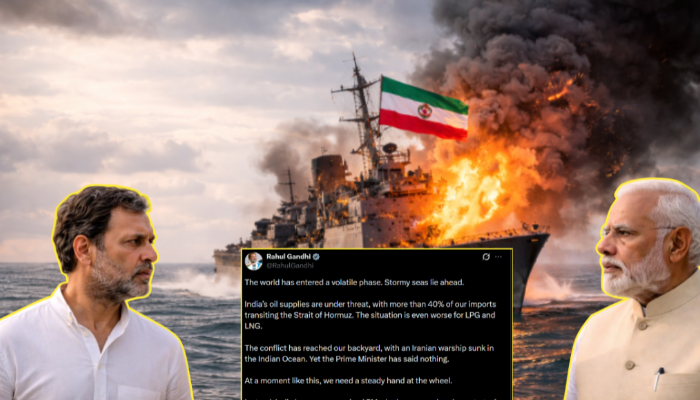
Rahul Gandhi outlined that India’s oil imports are at risk as over 40% of its imports use the Strait of Hormuz and the situation is even more dire for LPG (Liquefied Petroleum Gas) and LNG (Liquefied Natural Gas).
“The conflict has reached our backyard with an Iranian warship sunk in the Indian Ocean. Yet the prime minister has said nothing. At a moment like this, we need a steady hand at the wheel,” he stated while claiming that the latter is “compromised” and “has surrendered our strategic autonomy.” The fabricated narrative has been persistently promoted by the party in a latest effort to remove the ruling government.
The world has entered a volatile phase. Stormy seas lie ahead.
India’s oil supplies are under threat, with more than 40% of our imports transiting the Strait of Hormuz. The situation is even worse for LPG and LNG.
The conflict has reached our backyard, with an Iranian warship…
— Rahul Gandhi (@RahulGandhi) March 5, 2026
The sentiment was reiterated by another leader of the Indian National Congress, Pawan Khera, who questioned, “Does India have no influence left in its own neighbourhood? Or has that space also been quietly ceded to Washington and Tel Aviv?” This was retweeted by Arfa Khanum Sherwani, the chief propagandist of “The Wire.”
Today, an Iranian naval vessel – returning from the Milan 2026 International Fleet Review, where it had been invited by India – was sunk by a U.S. submarine at the edge of Indian waters near Sri Lanka.
Does India have no influence left in its own neighbourhood? Or has that… https://t.co/J0XEU3a8Z7
— Pawan Khera 🇮🇳 (@Pawankhera) March 4, 2026
Rajdeep Sardesai commented that the ship had conducted a naval program with the Indian navy close to the nation’s coastline only days ago, in the presence of President Droupadi Murmu before it was targeted by the US. “The ship was not engaged in any war-like activity when attacked. We don’t have any legal responsibility but moral responsibility surely. Will we tell the Americans that they have crossed a line here,” he asked.
An Iranian warship conducts a naval exercise with our Navy on our coastline just days ago with President of India in attendance. Leaves for home and is torpedoed by an American missile in the Indian Ocean not far away from our waters, leaving over 80 dead, many injured. The ship…
— Rajdeep Sardesai (@sardesairajdeep) March 5, 2026
Jawhar Sircar, former Rajya Sabha MP and member of the All India Trinamool Congress (AITC or TMC) posted an “The Indian Express” article written by C Uday Bhaskar, father of flop actress and full time propagandist Swara Bhaskar, to challenge India’s silence on the issue.
Why is India silent on US submarine strike on Iranian warship near India?
Naval warfare expert says sinking of Iranian naval by US submarine in
Indian Ocean near India raises awkward and complex political, diplomatic, and military questions for India.https://t.co/meUZhEo8zX— Jawhar Sircar (@jawharsircar) March 5, 2026
A member of this cabal went so far as to cry that the episode was “the biggest breach of trust in the history of friendships.” He then dramatically added, “A proper stab in the back. India will never be able to live it down.”
This is one of the biggest breach of trust in the history of friendships. A proper stab in the back. India will never be able to live it down. https://t.co/RfzcaQH89T
— 🇮🇳Gujjubhai Against War/apartheid (@Malavtweets) March 4, 2026
A person shared that the United States would not have had the audacity to take such an action within “India’s sphere of influence” under any prior government, including Congress, Bharatiya Janata Party or even Third Front. “That’s where we are today. I doubt Modi govt will react in any way,” he charged.
I don’t think the US Navy would have dared sunk the Iranian warship within India’s sphere of influence during the term of any previous govt, Congress or BJP or Third Front. That’s where we are today. I doubt Modi Govt will react in any way.
— Krishan Partap Singh (@RaisinaSeries) March 4, 2026
Another account alleged that the instance revealed India’s “ugly face,” insinuating that the government should have successfully prevented the strike because Iran was taking part in a naval drill in the country.
India’s Ugly Face Exposed 🚨📷 A few days ago, soldiers from an Iranian naval warship had participated in a joint parade in India on February 19. It is being said that in this video, all of them are Iranian naval soldiers who were martyred in an attack by America at sea. pic.twitter.com/mWJQzuOi9c
— bilalabdul khan (@Bilalahmed19870) March 5, 2026
Congress and its leaders, alongside the Islamists and their liberal allies, have consistently lashed out at India and the Modi government for their reluctance to take a stance or engage in the issue. They have invoked moral duty, influence and various other arguments to pressure and even discredit the government on an international scale.
The intense push to entangle India in an unrelated struggle with other powers
The prospect of war resulting from such aggressive standoffs between nations is detrimental to all and has adverse global consequences, akin to the significant threat hanging over energy trade routes with the shutdown of the Strait of Hormuz. Therefore, numerous countries have called for peace and restraint in response to the critical circumstances.
India too has appealed for peace and stated, “We are deeply concerned at the recent developments between Iran and Israel. India urges both sides to avoid any escalatory steps. Existing channels of dialogue and diplomacy should be utilised to work towards a de-escalation of the situation and resolving underlying issues.”
However, compelling New Delhi to take a position is not only politically sinister but might also pose a threat to its long-term strategic interests. Moreover, the allegations regarding India’s diminishing control are equally hollow as the ship was attacked in international waters which do not fall under the jurisdiction of the Modi government. The IRIS Dena sank outside the Exclusive Economic Zone (EEZ) of India.
This was a component of a series of actions by the United States, which aimed to eradicate Iran’s navy and was not connected to India. However, there is a deliberate intention to characterise it as a blot on the nation’s reputation, rather than another unfortunate aspect of the rivalry between the two foes.
Congress, which is even accused of colluding with figures like George Soros to undermine the current government has initiated a cacophony of criticism against PM Modi, disregarding the fact that he should prioritise his nation’s safety and interests rather than act to seek unnecessary accolades.
India has consistently adhered to its non-alignment policy and maintained a sovereign approach in relation to such affairs. It did not yield to the immense American pressure to align with Ukraine in the clash with Russia and urged both nations to end their hostilities. The centre has been particularly cautious during these critical times, given its friendly relations with both Israel and Iran as well as the United States. Who benefits if India is viewed as making a decision and forsaking its non-alignment stand?
Furthermore, the emotional appeals of justice and moral standing have no place in national interest or diplomacy, which is calculated and requires a careful balance. The government cannot abandon its extensive policies to appease ideological, political or religious zealots at home.
Does not every right-thinking and powerful nation conduct itself in this manner without the need for validation? Is Iran not striving for its best interests by blocking the Strait of Hormuz, thereby stopping the energy supply of massive economies like India? Notably, the Modi government has pointed out that there are enough fuel and crude oil stockpiles to last 6 to 8 weeks and it in a “reasonably comfortable” place to prevent shortages.
Conclusion
The repeated plots by these elements to pull India into every violent contest abroad, regardless of the legitimacy of their allegations or pronouncements, unveil a profoundly disturbing trend. They are eager to damage the country’s international reputation solely to discredit the Modi government. Their ambition for power and disdain for him have made the nation and its interests trivial in their larger scheme of things.