Article by Debalina Ghoshal
In Operation Sindoor, one of the biggest challenges was to counter adversaries’ cheap drones with expensive missile interceptors. The task of countering drones with missile interceptors was technologically feasible. However, economic feasibility became a challenge as expensive interceptors had to be employed for countering cheap drones. Starter drones could also be equipped with explosives for creating mayhem. In this context, the paper aims to examine the benefits of integrating an anti-drone system with missile interceptors.
The background
During this Operation, air and missile defence systems faced an economically daunting task of intercepting drones from Pakistan. This challenge was further aggravated when these expensive interceptors engaged dummy drones, rendering interception ineffective. These dummy drones will become economically challenging technology to counter, even in the near future, as adversaries would use drones as a cheap means to launch attacks on the Indian territory in times of crises and also use dummy drones to confuse air and missile defence interceptors. This means that strategic destabilisation could become an inexpensive process. Interception becomes a further complex task when swarm attacks occur via drones, as seen during Operation Sindoor, when Pakistan, under its Operation Bunyaan-al-Marsoos, tried to launch low-cost swarm drone attacks across India, proving the attack overwhelming for India’s air and missile defence capabilities. In addition, foot soldiers across the Line of Control (LoC) have started to face unprecedented threats from drone attacks. These concerns become more serious considering that Pakistan exercises revisionism as a means to counter India’s conventional military might.
These concerns have also been identified by India’s Chief of Army Staff, General Upendra Dwivedi, who has even gone to the extent of calling out on such actions as “not acceptable.”[1] According to the Chief, Pakistan was also asked to rein in the drones.[2] Such reactions must be treated in a positive light as it signals the fact that India’s military leadership does not wish to meddle with strategic stability by lowering the cost of inflicting strategic destabilisation on adversaries. That India’s top military echelons are not appreciative of making warfare inexpensive comes as a ray of hope in South Asian security, especially as Pakistan was willing to make warfare an inexpensive means by using such capabilities against civilian targets rather than confining such capabilities to only military targets. But adversaries’ perception of gaining combat advantage in warfare or conflict may not be similar to India’s own military leadership’s perception of gaining combat advantage. Thus, he also raised the issue of unmanned aerial systems (UAS), which cannot be confined to only surveillance roles in the present nature of warfare, and hence, their roles are now modified for countering drones, precision strike and reconnaissance also.[3] His concerns not only emanate from India’s own vulnerabilities that include both counter-force and counter-value objects being targets of inexpensive drones, but probably also from the Russian experience of nuclear bombers being destroyed by cheap Ukrainian drones under Operation Spider Web in 2025.[4]
‘Defence by denial’ is always an expensive strategy, but it is also a necessity to strengthen combat readiness and make a state’s ability to launch offensives more credible. Nevertheless, the use of such expensive defence means could provide logical sense against strategic and tactical ballistic and cruise missiles that are also expensive systems. If such systems are used for countering inexpensive systems and their dummies, the cost effectiveness of deterrence would be inversely proportional to the air and missile defence system. Multi-layered defence systems could also become an effective defence mechanism against electric-driven drones using both soft and hard kill approaches.
These technologies are conducive against Indian Army’s new warfare strategy that includes the transformation of its tactical battle space (TBS) from integrating low altitude air space or ‘air littoral’ with ground combat zones, This means that Indian Army will now seek to exert greater control over low altitude airspace which would require it to not only rely on airpower capability of the Indian Air Force, but its own capabilities of air and missile defence systems. Such a situation will also mean there is decentralisation of ‘defence by denial’ assets to suit real-time threats and crises. However, under such decentralisation mechanisms, it is only conducive that the Indian Army has its ‘defence by denial’ mechanism set in a way that it could counter all kinds of threats, including drones.

Global Developments in Counter-Drone Technologies
Every weapon must have a counter-defence. This is also applicable for drones, whose deployment in wartime as a cheap means of launching offensives has resulted in the development of counter-drone tactics and technologies. This section tries to study some of the technological advancements taking place in the field of counter-drone. It must be noted that this section only studies the advancements for research purposes and does not necessarily promote the technologies for India’s defence import market.
There is also an effort made by global players in the defence market on low-cost kinetic effectors for countering unmanned aerial systems. These systems are also called “hard kill” systems. This means kinetic options are also considered for countering drones. The United States is putting its effort to develop kinetic means to counter UAS. The Bumblebee V-2 is one such example with artificial intelligence software that would enable the system to identify and engage enemy UAS.[5]
States like Israel have explored the Iron Beam laser defence system for countering drones, as well as rockets, artillery and mortars (RAM) as low cost option. In 2025, it operationally deployed the system for negating the threat from drones to its territory. Laser technology to counter drones could become a cost-effective option, as studies suggest. This includes laser beam systems or directed energy weapons. States have already ventured into such technologies before a cost-effective option to counter RAM.
High-power microwave (HPM) anti-drone weapon systems could also become a powerful option for countering drones. HPMs could generate electro-magnetic pulse to make drone countering easier.Many venturing technologies like the Leonidas developed by Epirus, tech start-ups have also upgraded their technologies and use durable and less power-consuming gallium nitride (GaN) semiconductors to generate microwaves instead of power-consuming magnetron vacuum tubes.[6] These systems are reported to be capable of striking ‘one-to-many drones.’
In February 2026, Greece’s Centauros electronic anti-drone system was reported to be fully integrated with Israel’s Barak MX air defence platforms to enable detection, assessment and neutralisation of threats through electronic interference at low cost.”[7] This cooperation and integration are expected to resolve the high cost issues of interceptors for anti-drone roles. Thus, in present modern warfare, the challenge to counter drones could be resolved with integration with air and missile defence systems. This anti-drone capability could strengthen its ‘defence by denial’ capability further when air and missile defence systems are multi-layered. This provides the anti-drone systems deterrence by denial capability at every layer of offensive deterrence showcased by adversaries.
The concern for hybrid threats like drones and unmanned systems has also been raised by the European Union (EU). In fact, the EU has already come out with an Action Plan on Drone and Counter Drone security that focuses on “enhancing preparedness and resilience against drone incidents, strengthening detection capabilities through advanced communication networks, improving responses to malicious drone activities and reinforcing overall EU defence readiness.[8] The anti-drone market in the European Union is expected to grow by 2030 and reach USD4.16billion with major players like Leonardo (Italy), Thales and MBDA (France), SAAB AB (Sweden), Rheinmetall AG (Germany), to name a few.[9]
In fact, the Thunder Shield effector, a project of Thales, is a Directed Energy Weapon (DEW) that generates a short, powerful electromagnetic wave to neutralise a class of drones. This system could become effective against swarm drones given its high-power microwave capability.[10]
EU European countries, like Russia, are also developing and deploying counter-drone systems. Britain’s Non-Brighter Surveillance Systems Limited and BAE Systems are exploring the field of developing counter-drone systems.

India’s Venture Owing to Paradigm Shifts
India’s challenging scenarios during Op Sindoor have made New Delhi realise the relevance of air and missile defence systems. In 2025, India tested multi-layered air defence systems. This air defence system is an integrated air defence weapon system (IADWS) with Quick Reaction Surface to Air Missile (QRSAM), Very Short Range Air Defence System (VSHORAD) and high-powered laser-based Directed Energy Weapon (DEW). [11] Laser-guided rockets with airburst warheads, as seen in Ukraine, provided by Thales Belgium[12] could also become a possibility in the near future for India. As the Defence Minister Shri Rajnath Singh puts it in his tweet, the capability would “strengthen area defence for important facilities against enemy aerial targets.”[13] According to India’s Defence Secretary Rajesh Kumar Singh, India is indigenously developing multi layered long range surface-to-air missile system under Project Kusha. [14]
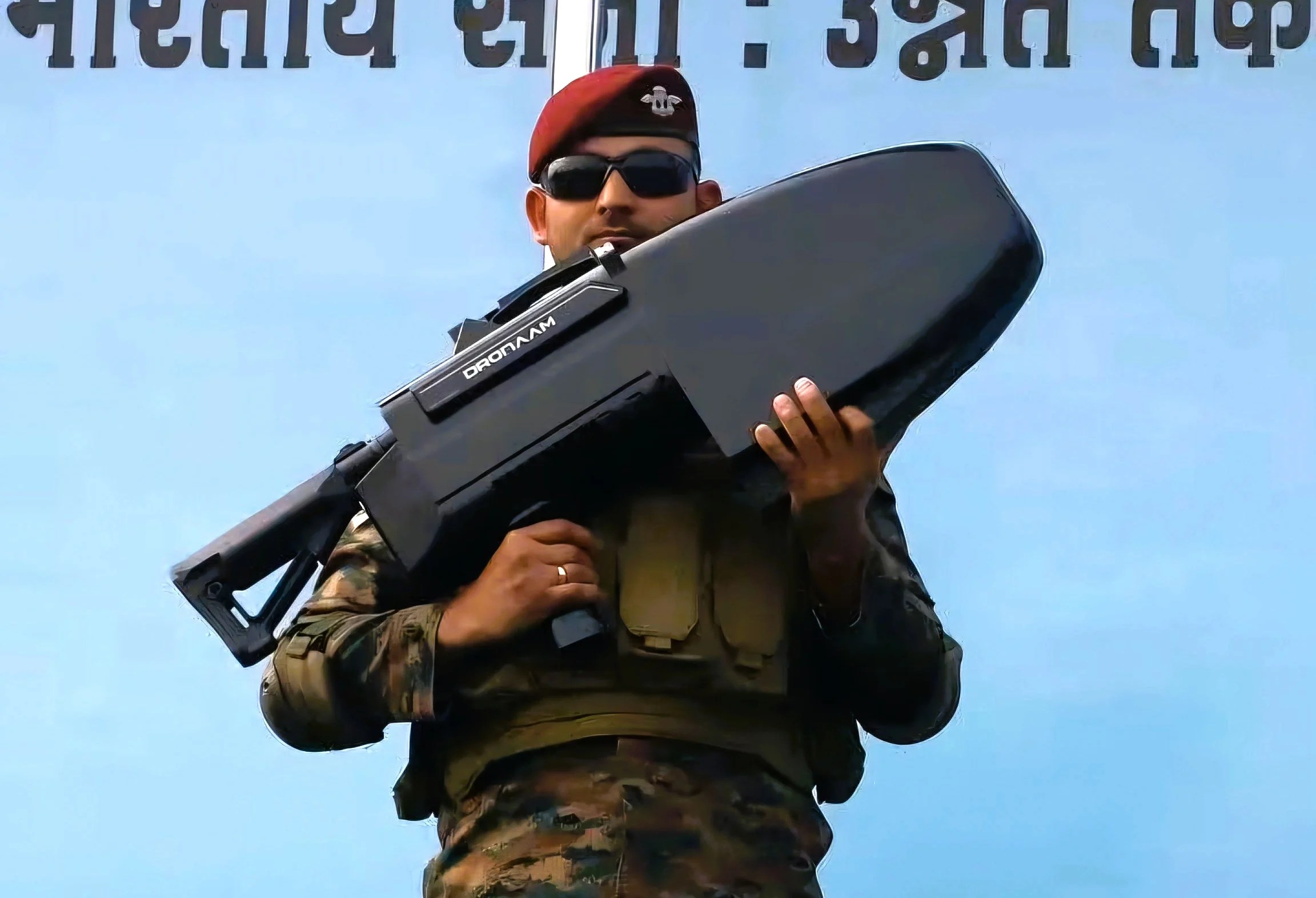
India has also ventured into the development of counter-drone systems. In 2025, reports confirmed that India had developed a low-cost counter-drone system called the Bhargavastra.[15] This system is reported to be capable of countering swarm drones through the detection and interception of such drones. The system is designed and developed by Solar Defence and Aerospace Limited (SDAL). The D-4 systems developed by Bharat Electronics Limited (BEL) have already successfully proved their mettle during Operation Sindoor. BEL is also venturing into an Artificial Intelligence (AI) powered counter-drone system called the Situational Awareness Kinetic and Soft Hard Kill Assessment Management (SAKSHAM) system. The Indian Army is set to start procurement of this system operating on a secure Army Data Network (ADN), providing a common “Recognised UAS Picture” across the TBS. [16] India will also acquire the Helma-P anti-drone laser from France under a deal, which is a high-energy laser system capable of accurately targeting and neutralising small drones and unmanned aerial vehicles (UAVs). [17] The Indian Air Force is also in favour of integrating Pantsir S-1 systems from Russia to protect its S-400 air and missile defence system.[18] This Pantsir S-1 could possess integrated electronic warfare systems to destroy drones.

Conclusion
Revisionist states will pursue a variety of warfare tactics to achieve their objectives, regardless of the ethical implications. It is advantageous when such tactics are also economically feasible for the state, allowing for sustained military initiatives without draining resources excessively. Consequently, India has judiciously advanced its modernisation process, which now encompasses cutting-edge technological solutions designed to counteract systems that threaten to destabilise India’s strategic and tactical deterrence capabilities. By investing in advanced defence technology and fostering innovation, India aims not only to enhance its national security but also to establish itself as a formidable player on the global stage. This proactive approach reflects an awareness of the complexities of modern warfare.
[1] Shivani Sharma and Manjeet Negi,” India Today, January 13, 2026,
[2] Rahul Singh, “Pakistan told to rein in drones: Army chief Upendra Dwivedi on intrusions,” Hindustan Times, January 14, 2026,
[3] Pradipta Mukherjee, “Army Chief’s Bigger Role for Drones in Future Wars!,” MAVDRONES, September 8, 2025,
[4] Laura Gozzi and BBC Verify, “How Ukraine carried out daring ‘Spider Web’ attack on Russian bombers,” BBC, June 3, 2025,
[5] Zita Ballinger Fletcher, “US Army to debut FPV Bumblebee V2 drone interceptor next month,” Military Times, February 14, 2026,
[6] David Szondy, “Microwave weapon downs 49 drones with a single blast,” New Atlas, September 27, 2025,
[7] Stavros Ioannidis, “Greek Centauros anti-drone system joins Israeli missile shield,” Ekathimerni, February 2, 2026,
[8] “Hybrid Threats,” European Commission,< Hybrid Threats>
[9] Leonardo S.p.A. (Italy) and Thales (France) are Leading Players in the Europe Anti Drone Market,” Markets and Markets,< Leonardo S.p.A. (Italy) and Thales (France) are Leading Players in the Europe Anti Drone Market>
[10] “Thunder Shield- High-Power Microwave Electromagnetic Neutralisation of Drones,” Thales,< ThunderShield™ – High-Power Microwave Electromagnetic Neutralisation of Drones | Thales Group>
[11] “DRDO successfully conducts maiden flight-tests of Integrated Air Defence Weapon System,” PIB, August 24, 2025,
[12] Tim Zadorozhyny, “Thales arms maker delivers new missiles to Ukraine designed to take out Russian drones,” The Kyiv Independent, October 7, 2025,
[13] Rajnath Singh, Tweet,
[14] “India Hints at Project Kusha Breakthrough Following Suspected Test Activity,” Indian Defence Research Wing, February 8, 2026,
[15] “India’s own grown ‘Bhargavastra’ counter swarm drone system test fired successfully,” The Hindu, May 14, 2025,
[16] Aditya Raj Kaul, “Army Launches Indigenous ‘SAKSHAM’ Anti-Drone Grid to Boost Air Defence,” NDTV, October 9, 2025,
[17] “France to supply India with the weapon it needed to lock in its military doctrine: the HELMA-P anti-drone laser,” Merino Homes News, February 20, 2026,
[18] Raghav Patel, “IAF Backs Integration of Russian Pantsir Systems to Fortify S-400 Against Low Flying Drones and Cruise Missiles,” Defence.in, February 14, 2026,