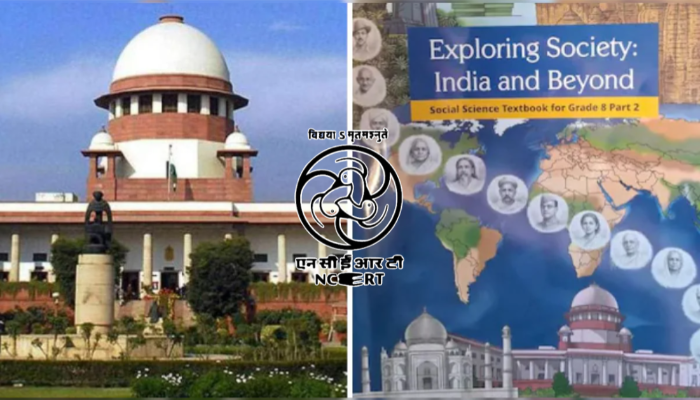
On 24th February (Tuesday), the National Council of Educational Research and Training (NCERT) released “Exploring Society: India and Beyond (Part 2, First Edition),” a class 8 textbook that featured updated chapters addressing challenges encountered by the judiciary, including corruption and the accumulation of pending cases.
The move did not sit well with the Supreme Court as it announced a complete ban on the publication on 26th February (Thursday). It remarked that the inclusion of such material in a textbook intended for high school pupils was a deliberate attempt to discredit and undermine the judiciary’s dignity and pronounced that the scandalisation of the institution seemed to be tantamount to criminal contempt.
NCERT and Ministry of Education under fire
A three-judge panel, led by Chief Justice of India Surya Kant and consisting of Justices Joymalya Bagchi and Vipul M Pancholi, referred to the new release as criminal contempt of court. Furthermore, the NCERT Director, the Ministry of Education and the Secretary of School Education were also served with a contempt notice, which required them to explain why they should not be charged with contempt of court.
The NCERT Director was also told to provide the identities of those who prepared the controversial chapter. The original meeting minutes from the section where the same was discussed and decided upon must be presented on the following hearing date in accordance with the direction.
“It shall be the personal responsibility of the NCERT Director and the principal of every school where the book has reached to effectuate immediate seizure and sealing of all copies of the book in their premises, and submit a compliance report. Ensure that no instruction is imparted based on the subject book. Principal Secretaries of all states are to comply. Compliance to be sent within 2 weeks,” the justices declared.
They added, “Any attempt to circumvent this order through electronic means or altered titles shall be seen as direct interference, willful breach and defiance of directions.” The court also directed that people who authored and defended the chapter will not be associated with the NCERT or any other ministry in future and stated, “Thats very little consequence. They fired a gunshot, the judiciary is bleeding today.”
Heads must roll: CJI’s furious reaction
According to Kant, the judiciary’s distinguished past and its contributions to the preservation of legal help, access to justice, the basic structural doctrine and constitutional morality have been ignored. He mentioned that the book opted not to explore the court’s revolutionary efforts and actions. He stressed that exposing impressionable young minds to such a biased narrative could result in long-lasting misconceptions and added that the book is going to reach not only students but also teachers, parents and the next generation.
The chief justice wanted heads to roll because the book was a part of a long-running, carefully planned plot to discredit the court but insisted that the goal was to preserve the integrity of the national curriculum and the institution’s reputation, not to quell valid criticism.
The apex court forbade the book from being published, reprinted or distributed digitally in any manner. It also warned that any attempt to get around the directive by using electronic means or changing the title would be viewed as a wilful violation and direct interference with the administration of justice.
Additionally, it mandated that all existing physical and digital copies, including those in storage, retail stores and educational institutions, be immediately confiscated and removed from public access.
Solicitor General Tushar Mehta, representing the centre, issued an unqualified apology on the part of the government and NCERT. He promised that individuals in charge of the chapter would not be connected to the Ministry of Education or NCERT in the future and promised to release an even more unequivocal public apology. He disclosed that just 32 physical copies had been distributed and would be retrieved.
The root of the row
A dearth of judges, extensive case backlogs and judicial corruption were touted as the three main issues facing the judiciary in Chapter 4, “The Role of the Judiciary in Our Society.” It outlined hundreds of complaints brought against judges and even mentioned the statement by a former Chief Justice of India to highlight that even the judiciary had admitted the structural corruption.
“Sadly, there have been instances of corruption and misconduct that have surfaced even within the judiciary. Such occurrences inevitably have a negative impact on public confidence, potentially eroding faith in the integrity of the system as a whole,” the book cited B R Gavai’s last July’s remark.
He had further conveyed, “However, the path to rebuilding this trust lies in the swift, decisive and transparent action taken to address and resolve these issues. Any erosion of this confidence risks weakening the judiciary’s constitutional role as the ultimate arbiter of rights. Transparency and accountability are democratic virtues.”
The art of avoiding accountability, responding with hostility to the barest reference of severe issues that blemish the judiciary
The judiciary, which purports to be the “protector of democracy,” simultaneously defends itself aggressively against even the slightest attempts at scrutiny and accountability. It claims to welcome criticism but reacts defensively when asked to confront the longstanding issues that have plagued it for decades and even pointed out by its own members, such as Gavai.
The latest NCERT edition sought to educate the students about the genuine challenges encountered by one of the key constitutional institutions. However, this was perceived as contempt of court which essentially suggested that the judiciary is infallible, and anyone, including the elected government, who dares to shed light on the legitimate concerns will be brought to heel.
Critique, opposition and backlash are part and parcel of a democratic nation like India which is directed at everyone, from the most powerful politicians to local politicians, media personalities, doctors, actors and individuals from various other fields. It is regarded as the true spirit of freedom of expression.
However, the Indian courts which pride themselves as the guardians of fundamental rights and the Constitution cannot be subjected to the same liberties, as any disagreement or dissent could be classified as their “contempt,” delivering a tight slap to the ideals they assert to uphold.
The judiciary has created a distinct set of regulations that enable them to function in line their preferences, safeguard their own interests and intervene in dieffrent matters. However, it remains immune to any examination as even the most innocuous conversations about its corruption is abruptly silenced without a moment’s pause.
The judiciary appears to operate beyond the reach of all laws and even the Constitution, where all are answerable to its jurisdiction but it bares no such obligation towards anyone. Can such a country truly be called a democracy when one institution possesses unrestrained power while others must remain in fear of when and how the authority might be wielded against them?
Judge Yashwant Varma’s cash scandal
On 14th March 2025, a significant sum of unaccounted money was found during a fire at Delhi High Court Justice Yashwant Varma’s residence on Holi. Videos of partially burnt notes appeared online, resulting in inquiries over the surfacing of such a large amount at the place of a sitting judge. The controversy continued to intensify forcing then Chief Justice of India (CJI) Sanjeev Khanna to launch a 3-member committee for an internal probe.
Varma’s judicial duties were suspended while the investigation was conducted and he was repatriated to the Allahabad High Court. The panel presented its findings which prima facie marked him guilty. Khanna submitted the report to the president and the prime minister for further action after Varma refused his request to resign.
The judge was just transferred to a different court and instructed to vacate his position, which he blatantly rejected. Moreover, the matter is currently under investigation while he lives a life of ease. Importantly, no judge has ever been impeached in independent India, even after grave allegations of corruption made by individuals like Gavai and proceedings started against multiple names.
The initial judge who was targetted with an impeachment motion was Justice V Ramaswami who would have been the first to be dismissed if the opposition’s resolution had been accepted by the Lok Sabha. The proposal failed when 205 members of Congress and a few members of other parties abstained. Ramaswami later rose to join the Supreme Court, despite a controversial career.
Likewise, the first person to be declared guilty by the Rajya Sabha was Justice Soumitra Sen of the Calcutta High Court. However, he resigned before the resolution reached the Lok Sabha, avoiding official impeachment. The most extreme penalties for guilty judges seem to involve transfer, retirement or resignation.
Does a common individual possess the same privilege in the eyes of the law? Would he or she also have been spared with a similar reprimand without facing any real-life consequences? What else could this be but a flagrant misuse of authority and power to shield even the most compromised elements of the judiciary, while the lives of ordinary citizens can be shattered for minor infractions, and in some cases, even innocents have to spend decades in prison.
No public asset declaration for the judiciary
It is not possible to address Varma’s case independently without considering the repeated Supreme Court verdicts observing that public disclosure of the assets owned by judges is not required and is optional owing to the 1997 verdict. They unveil their possessions but to the chief justice and the details can be accessible to public only voluntarily. This implies that a judge has the option to decide whether or not to reveal their holdings to the Indian public.
The court’s emphasis on privacy under the Right to Information (RTI) Act, 2005 reflects the fact that the revelation is not compulsory. The position has also been maintained in a number of cruicial decisions, such as the one rendered in 2019, which supported disclosure only after the illustration of a greater public interest.
The apex court has admitted that judges are public servants but its decisions such as Chief Justice of India K G Balakrishnan’s 2008 ruling and Lokpal’s conclusion on 3rd January 2025 affirmed otherwise. It is important to note that declaring assets is critical for all other public servants, including MPs and MLAs. It is mandatory for candidates before running for office and legal actions transpire if the statement is regarded suspicious.
This conveys that only judges are not legally required to share the data about their properties, unlike politicians, bureaucrats, lawyers or ordinary persons, serving as a major reminder of the inequality that exists inside the country. Does this not position judges above all other citizens and also create a potential loophole for them to engage in dubious activities and accumulate vast wealth with impunity?
The repeated judgements act as insulated armour against any charges irrespective of the merits providing undue advantage. Thus, how can the claims of impartiality, honesty and justice be accepted as truthful when the evidence points to the contrary?
The alarming admission of bench fixing
Anti-Hindu Delhi riots accused Umar Khalid’s father, SQR Ilyas, a former member of banned Students Islamic Movement of India (SIMI), acknowledged that their lawyer, Kapil Sibal, was attempting to bench fix during the hearings, in an article of “The Indian Express.” OpIndia had reported the same which was also verified by former Chief Justice DY Chandrachud.
“In normal practice, if a hearing is postponed in the Supreme Court, the case is reassigned to a new bench. Yet, in Khalid’s case, the matter repeatedly appeared before the same judge for six consecutive hearings. Faced with this, his lawyers eventually withdrew the plea, resolving to try their luck again in the lower courts. Since bench allocation is determined by the Chief Justice, it is evident that this repeated assignment was not a coincidence. Now, following the high court’s latest rejection, the only option once again is to approach the Supreme Court,” he wrote in his piece “India needs a people’s movement against UAPA (Unlawful Activities Prevention Act).”
Umar Khalid and his attorney Kapil Sibal took 7 of the 14 adjournments because the accused did not want the case to be heard by Justice Bela Trivedi, which is a typical case of bench-fixing, prompting these adjournments. They even went so far as to urge the chief justice to personally hear the case but he rejected their attempt at forum shopping. Hence, similar to Ilyas in the column, Sibal withdrew the appeal from the Supreme Court alleging delay.
It is easy to comprehend that the corrupt practice of “bench fixing,” “bench hunting,” or “forum shopping,” which aims to have case sassigned to certain judges or court for a beneficial decision is also prevalent in India. What could more profoundly impact the objectivity of the legal system than verdicts pronounced with the client or counsel in mind rather than the veracity of the arguments or the evidence? What does this entail for an ordinary citizen who struggles within the legal system, while the influential and privileged not only secure the judge they desire but also massively enhance their chances of a favourable ruling?
The collegium system
The collegium system, which allows a collective of senior judges to suggest appointments and transfers to India’s higher judiciary is a primary example of how the judiciary operates as a network of interconnected and tightly-knit group who meticulously protect their system and all its members. The system does not have a clear basis in the Constitution or its amendments.
A collaborative approach between the executive and judiciary is implied by Articles 124(2) and 217(1), which require the president to select judges of the Supreme Court and High Courts after consulting with the Chief Justice of India and other specified judicial leaders. However, this consultation was changed into acquiescence by judicial interpretations, particularly the Second Judges Case (1993) and the Third Judges Case (1998), which gave the judiciary precedence and reduced the role of the executives.
The Chief Justice of India and the four most senior Supreme Court justices form the collegium, which was established by the Memorandum of Procedure in 1947 and developed over many years. With rare exceptions, their recommendations have almost a binding force.
The Modi government wanted to rectify this opaque system with the pivotal National Judicial Appointments Commission (NJAC) Act. It was a 6-member constitutional body tasked with supervising the appointment of judges to the Supreme Court and High Courts, including the Chief Justice of India, two senior judges, the Law Minister and two distinguished individuals.
The intention was to establish a more open, inclusive, and responsible system for selecting judges. However, the act was struck down by the apex court and the development was dubbed as “tyranny of the unelected” by late Arun Jaitley in 2015. Clearly, even a minimal attempt at accountability and transparency is rejected by the judiciary, which espouses these virtues but when it applies to others.
Conclusion
The aforementioned instances do not even scratch the surface of the deep-seated problems within the Indian judiciary. The current controversy regarding the NCERT textbook is a continuation of its decades-old conduct, which demands accountability from others yet becomes furious at the mere reference to the issues that afflict it and already been addressed by other judges. It exhibits an uncanny tendency to not only protect its own interests but also to project a pristine image even while its actions are ridden with shocking hypocrisy and double standards.