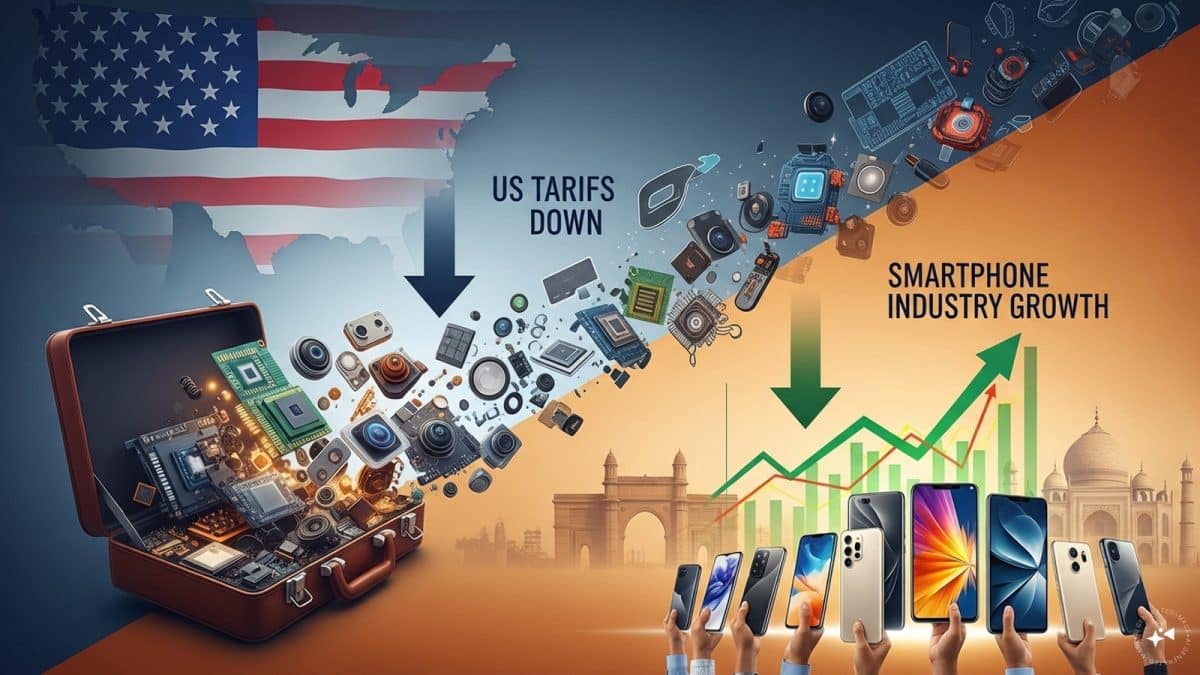
US lowers its tariffs on Indian goods to an 18 per cent ceiling from a steep 50 per cent, marking a significant shift in trade policy. The move is being viewed as a major boost for India’s electronics and semiconductor exporters, who have grappled with unpredictable tariff regimes and uncertainty across global supply chains.
The United States and India have sealed a landmark trade deal that could reshape the dynamics of the global electronics and semiconductor ecosystem, and potentially make your next smartphone a little cheaper.
Announced on February 2, 2026, the
agreement cuts US tariffs on Indian goods to an 18 per cent ceiling, down from a steep 50 per cent. In return, India has agreed to lower its own trade barriers and step up imports of US energy, technology and agricultural products.
Industry observers say the deal injects much-needed stability into a fast-growing bilateral trade corridor. Rajeev Singh, Managing Director, BenQ India & South Asia, told Firstpost, “The reported reduction of US tariffs on Indian goods as part of evolving trade discussions presents a meaningful opportunity for India’s technology sector to expand its global reach and competitiveness, particularly in electronics and adjacent hardware manufacturing.”
He added, “Lower tariff barriers can help Indian tech companies achieve more predictable market access, improve cost structures, and foster deeper collaboration with international partners”
For Indian manufacturers, especially those in the smartphone and consumer electronics segments, this means greater policy predictability and a lower risk of sudden tariff shocks, factors that directly influence pricing and production planning.
Boost for smartphone manufacturing
India’s smartphone exports to the United States have surged dramatically, tripling to $12.54 billion between April and November FY26 from $4.1 billion a year earlier, according to commerce department data. The tariff relief is expected to accelerate this trend, reinforcing India’s status as a rising electronics manufacturing powerhouse.
Electronics manufacturing depends on tightly integrated global supply chains, where components and sub-assemblies often cross borders multiple times before final assembly.
By lowering friction across these routes, the new tariff framework helps manufacturers cut costs and improve efficiency. This could eventually translate into more competitive pricing for smartphones in the US and India, though the impact will unfold gradually.
Companies such as Apple and its primary contract manufacturer, Foxconn, are already positioned to benefit. Apple now produces multiple iPhone models in India, with a large share destined for export markets.
Semiconductors and the high-tech ecosystem
Beyond smartphones, the deal links broader India–US cooperation under the TRUST and iCET initiatives, which aim to align critical-mineral access, trusted chip manufacturing, and advanced packaging between the two countries.
Singh added, “This comes at an opportune time as India reinforces its semiconductor and electronics ecosystem through measures such as the enhanced
India Semiconductor Mission 2.0 in the Union Budget 2026, which strengthens domestic manufacturing and innovation.”
While Washington continues to maintain selective restrictions on sensitive semiconductor products for national security reasons, the overall easing of trade barriers improves the business case for locating chip design, testing, and fabrication activities in India. These efforts are particularly relevant for 5G, 6G and data centre applications, all key growth areas for both economies.
Sector watchers believe Indian telecom and electronics firms stand to gain most where they move up the value chain into specialised domains such as Open RAN subsystems, secure network equipment and advanced chip packaging. The tariff reforms, they note, are less about immediate cost savings and more about building long-term trust and supply-chain resilience.
Together, the tariff reset and technology cooperation mark a deeper alignment between Washington and New Delhi, one that could strengthen both nations’ roles in the evolving global tech landscape. For consumers, the benefits may first appear in the form of more affordable smartphones; for manufacturers, it signals the beginning of a more stable, predictable, and opportunity-rich decade.
End of Article